





.jpg)






Description
-
BrandRolls-Royce
-
ModelH1111.0203
-
Product NameMarine Controller
-
Place of OriginUnited Kingdom
-
Customs HS Code85423190
-
Power Supply18–32 Vdc
-
Dimensions250 mm × 200 mm × 100 mm
-
Weight2.07 kg
-
Operating Temperature-20 ℃ ~ +55 ℃
-
Storage Temperature-40 ℃ ~ +70 ℃
-
Warranty12 month
-
Product Statusnew
Wiring Method for Rolls-Royce H1111.0203 Marine Controller
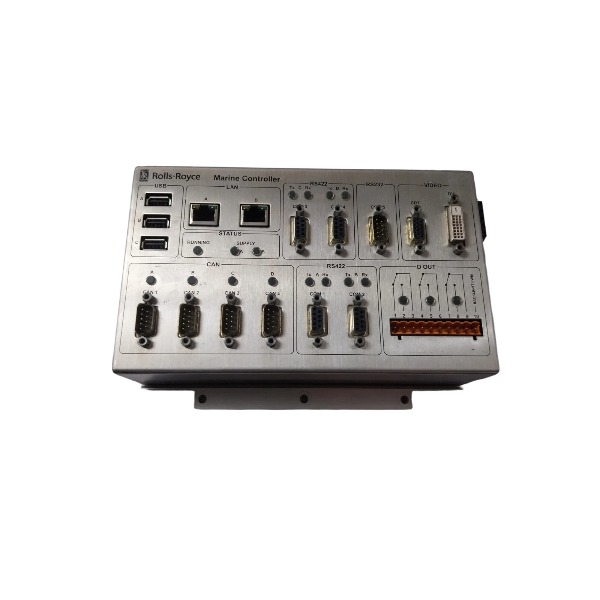
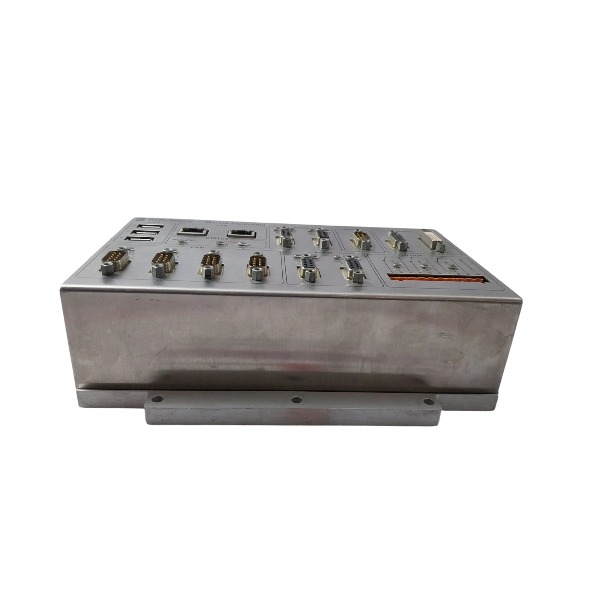
This marine propulsion controller combines terminal blocks and D-Sub connectors for field wiring.
Power circuit: It operates on 24 VDC with an allowable range of 18–32 VDC. Positive and negative poles must be connected correctly. Redundant power supply is available to meet high-reliability marine requirements, and a dedicated protective earth conductor links the controller chassis to the cabinet grounding bus.
Digital inputs and outputs: DI/DO signals are routed through terminal blocks, supporting dry contact or 24 VDC level signals. Freewheeling diodes are required for inductive loads to suppress back electromotive force.
Analog channels: Shielded twisted-pair cables are used for RTD and thermocouple inputs. The shield is grounded only at the controller end to prevent ground loop interference.
CAN bus: CAN_H and CAN_L adopt shielded twisted-pair cables. 120 Ω terminating resistors shall be installed at both ends of the main bus.
RS422 serial interface: It uses differential signal wiring with single-point shield grounding. Wiring polarity must match the A/B labels on the D-Sub connector.
Ethernet communication: Shielded CAT5e cables are applied to dual Ethernet ports for network redundancy, supporting Modbus TCP and system interconnection.
USB interface: Reserved for local program downloading and commissioning; it is not intended for permanent field wiring.
Power cables and signal cables shall be laid separately. Cable shielding design needs to satisfy DNV marine EMC specifications.
Conduct wiring inspection, insulation resistance test and continuity test before energization. All wiring work must follow the official Rolls-Royce wiring diagram.
D-Sub connectors and power terminals cannot be hot-swapped when the device is powered on.

Start by inspecting the 24 VDC power supply and confirm the voltage remains within the 18–32 VDC operating range. Check for loose terminals, reversed polarity, excessive voltage drop and blown fuses. Validate redundant power paths if they are implemented.
Examine front-panel status LEDs to classify faults such as power alarms, communication breakdowns, I/O channel errors and system failures.
Enter the controller’s built-in diagnostic menu to retrieve fault codes, event logs and time-stamped trip records, which serve as the main reference for fault location.
For CAN bus failures: Verify CAN_H / CAN_L polarity, condition of the shielded twisted cable, 120 Ω terminating resistors at both bus ends, and resolve ground loop interference.
For RS422 and Ethernet communication issues: Confirm cable shielding, single-point grounding arrangement, pin assignments, station addresses and baud rate consistency with paired devices.
For analog input faults involving RTDs and thermocouples: Check sensor wiring for open or short circuits, shield grounding and conductor resistance. Swap sensors or cables for verification.
For digital DI/DO malfunctions: Measure dry contact states and 24 VDC loop voltage. Inspect freewheeling diodes fitted to inductive loads to avoid back EMF harming output channels.
For intermittent faults: Evaluate cabinet temperature, vibration, humidity and cable strain points. Pay special attention to terminals and connector pins subject to constant vibration on vessels.
Connect with the official Rolls-Royce configuration software for online diagnosis, log export, real-time signal monitoring and carefully controlled forced I/O testing.
In cases of boot failure or program corruption, check the integrity of program files and restore the project from a verified backup.
Avoid disconnecting D-Sub connectors and power terminals while the unit is energized. Complete an insulation test before reapplying power after any rewiring work.
If wiring and software checks return no root cause and hardware damage is suspected, replace the controller with a spare for cross-comparison testing.
All troubleshooting operations must conform to marine classification society requirements and the official Rolls-Royce service manual.

FAQ: Rolls-Royce H1111.0203 Engine Control Module
Q: What is Rolls-Royce H1111.0203?
A: Rolls-Royce H1111.0203 is an engine control module, designed for marine gas turbine and diesel engine monitoring, speed regulation and safety protection control.
Q: What are the main functions of Rolls-Royce H1111.0203?
A: It performs engine speed control, fuel regulation, operating condition monitoring, fault diagnosis, alarm output and emergency shutdown protection for marine power units.
Q: What are the typical applications of Rolls-Royce H1111.0203?
A: It is mainly used for marine propulsion engines, auxiliary generator sets and offshore platform power systems equipped with Rolls-Royce power equipment.
Q: What communication interfaces does Rolls-Royce H1111.0203 have?
A: It supports serial communication and fieldbus interfaces to exchange operating data with ship DCS, alarm monitoring systems and local display units.
Q: What power supply does Rolls-Royce H1111.0203 require?
A: It adopts marine-grade DC power supply, stable input is required to adapt to the power fluctuation environment on vessels.
Q: What software is used to configure and troubleshoot Rolls-Royce H1111.0203?
A: Special Rolls-Royce commissioning software is required for parameter tuning, fault code reading, log checking and firmware maintenance.


.jpg)

.jpg)
.jpg)