





.jpg)
FD01105D5AB449D19960ADF9265827B2.jpg)
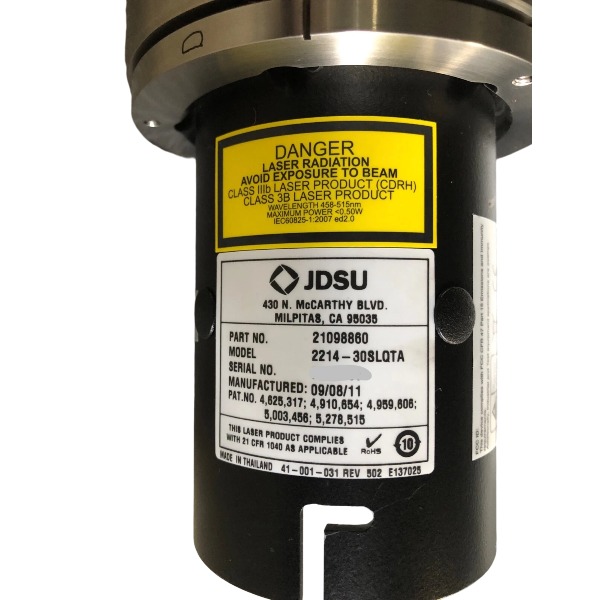







Description
-
BrandJDS Uniphase
-
Model2214-30SLQTA
-
Product NameAir-Cooled Single-Line Argon-Ion Laser Head
-
Place of OriginUnited States
-
Customs HS Code90132000
-
Power Supply90–110 Vdc
-
Dimensions305 mm × 280 mm × 70 mm
-
Weight3.38 kg
-
Operating Temperature+4 ℃ ~ +40 ℃
-
Storage Temperature-30 ℃ ~ +60 ℃
-
Warranty12 month
-
Product Statusnew
Common Faults and Solutions for JDS Uniphase 2214-30SLQTA Argon Ion Laser
Laser tube fails to ignite: Test the continuity and voltage of the filament circuit. Examine high‑voltage ignition cables and connectors for looseness or corrosion. If ignition pulses are audible yet the tube cannot strike, check the internal gas pressure of the laser tube. Replace the tube if gas leakage is confirmed.
Laser shuts off right after ignition: Verify the current regulation of the power supply and the running condition of the cooling fan. Inspect the overtemperature protection circuit and temperature sensor. Remove dust from heat sinks to improve heat dissipation.
Low or fluctuating optical output power: Clean the cavity mirrors and output window using approved optical cleaning materials. Check for cathode sag inside the tube and monitor drive current stability. Replace the laser tube when aging causes irreversible power degradation.
Flickering beam and intermittent laser output: Inspect high‑voltage terminals and signal connectors for poor contact. Check whether the mirror mounting brackets are loose. Eliminate AC ripple and instability originating from the laser power supply.
Overtemperature alarm and thermal shutdown: Confirm fan speed and ensure air inlets and outlets are unobstructed. Clear dust buildup inside the laser head. Check for drift or damage of the temperature sensor.
Activated safety interlock with no laser output: Inspect all interlock switches, door interlocks and remote interlock wiring. Restore closed‑loop interlock connections once open‑circuit points are located and fixed.
Severe high‑voltage arcing: Check insulation of high‑voltage wires and terminals, and wipe away dust and conductive residues. Keep the laser head enclosure dry to avoid surface creepage discharge.
No filament illumination after power on: Measure filament supply voltage and check fuses. Test the filament winding for open circuits. Replace the laser tube if the filament is burnt out.
Warning: Do not adjust mirror assemblies or take high‑voltage measurements without proper protective gear. All optical maintenance and tube replacement must follow the official JDS Uniphase service manual and applicable laser safety standards.

Cut off the main AC power and allow adequate time for high-voltage capacitors to fully discharge before inspection to prevent electric shock risks.
Locate the filament terminals connecting the laser head and power supply, and confirm pin assignments by referring to the official wiring diagram.
Set a multimeter to resistance range to test the continuity of the filament winding. A steady low resistance value means normal continuity; an open-circuit reading indicates a burnt filament.
Examine filament cable connectors for looseness, oxidation, corrosion or damaged pins. Clean tarnished contacts and reattach connectors securely.
Re-energize the system safely and measure the AC voltage at the output of the filament transformer. Compare the reading against the rated voltage for this laser model.
Test for vibration-induced intermittent open circuits: gently move filament cables and terminals while tracking resistance. Fluctuating readings signal poor contact.
Check the filament fuse and protection circuitry on the power supply board. Replace a blown fuse with one of identical rating; never install overrated fuses.
If resistance and wiring are intact yet no filament voltage is present, troubleshoot the filament transformer, drive circuit and associated control interlocks on the power supply.
Notes: The filament circuit is independent of the high-voltage ignition circuit, but hazardous residual high voltage still exists within the laser unit. Insulated tools and laser safety goggles must be worn during the entire test procedure.

FAQ: JDS Uniphase 2214-30SLQTA Air-Cooled Argon Ion Laser Head
Q: What is JDS Uniphase 2214-30SLQTA?
A: JDS Uniphase 2214-30SLQTA is an air-cooled single-line argon ion laser head from the 2214 series, CW continuous wave laser, optimized for 488 nm output at 30mW, widely used in precision optical inspection systems.
Q: What does the suffix SLQTA mean for 2214-30SLQTA?
A: SL stands for single line output, QTA represents the optical binning and configuration variant tuned for stable 488 nm TEM00 beam performance.
Q: What is the wavelength and output power of 2214-30SLQTA?
A: Primary wavelength is 488 nm, typical rated output power is 30 mW with high-quality TEM00 Gaussian beam.
Q: What power supply does JDS Uniphase 2214-30SLQTA need?
A: This is only the laser head; it must pair with the matching JDS Uniphase 2214-PS dedicated laser power supply module.
Q: What are the main applications of 2214-30SLQTA?
A: Commonly deployed on KLA-Tencor wafer inspection tools, confocal microscopy, optical metrology, semiconductor surface scanning and laboratory optical systems.



.jpg)
.jpg)