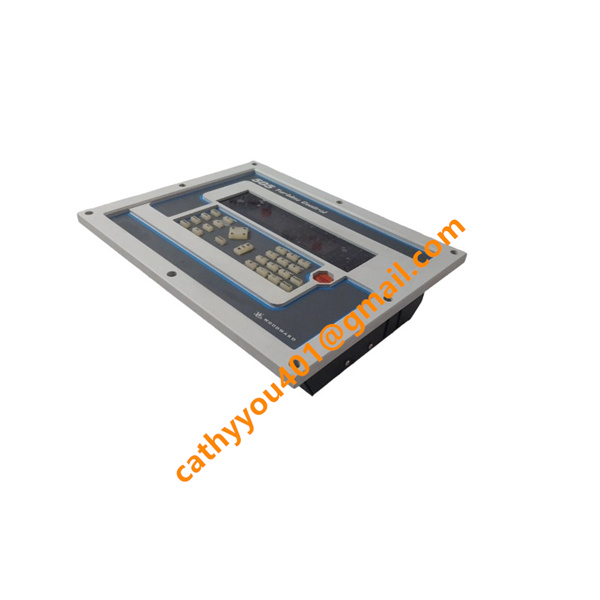













Description
-
BrandWoodward
-
Model9907-252
-
Product NameLoad Sharing Module
-
Dimensions273.6 mm × 214.1 mm × 59.2 mm
-
Weight1.40 kg
-
Place of OriginUnited States
-
HS Code85389000
-
Operating Temperature-40 °C to +70 °C
-
Storage Temperature-60 °C to +87 °C
-
Power Supply0.5‑4.5 V DC
-
Warranty1 year
-
Statusnew brand
Woodward 9907-252 Working Principle
The 9907-252 is a standalone load-sharing module applied for parallel-operated generator sets. It does not implement direct speed control. Instead, it sends speed trim correction signals to the prime-mover speed governor to achieve even active-power distribution among multiple paralleled generating units.
Signal Acquisition
The module takes three-phase voltage inputs from potential transformers (PT) and three-phase current inputs from current transformers (CT). Internal power-measuring circuitry computes the real-time active power of the local generator from voltage, current and power-factor data. The measured load value passes through filtering to suppress transient noise and disturbances.
Load Comparison and Deviation Calculation
Under isochronous mode, the module compares the actual load of the local unit against a common load reference transmitted via the shared parallel bus among all connected modules. A load deviation will be calculated once unbalance occurs between generators.
Under droop mode, no shared reference signal between units is needed. The module produces proportional droop corrections according to local load level, simulating speed-drop characteristics as load increases. This mode fits interconnection with infinite utility grids and parallel operation of multi-brand generator sets.
Analog Correction Output
According to the computed load deviation, the module outputs a 0.5-4.5 V DC analog trim signal to an external speed governor with 0-5 V speed-set input. Higher output voltage raises the engine speed set-point to increase power output; lower output voltage reduces the speed set-point to decrease power output. Consequently, each generator carries load proportionally to its rated capacity.
Closed-loop Dynamic Regulation
Repeated cycles of signal sampling, deviation comparison and correction output form closed-loop load-sharing control. An on-board gain potentiometer adjusts response performance: higher gain accelerates corrective action, while lower gain prevents hunting oscillation under variable-load conditions. Note that this module only handles load distribution; fundamental speed stabilization is completed by the native engine speed governor.
Auxiliary Logic
It works with an external synchronizer to complete pre-synchronization prior to generator breaker closure. The load-sharing function activates automatically after the breaker closes. When the generator circuit-breaker opens, load-sharing correction is inhibited, preventing undesirable speed drift when the unit runs in standalone condition.

Woodward 9907-252 Application Cases
Case 1: Multi-Generator Island Parallel Power Supply for Industrial Plants
A chemical plant is equipped with three 800 kW diesel generator sets to provide independent island power supply for on-site production. Each generator is fitted with a third-party electronic speed governor that supports 0–5 V speed trim input. Every unit is installed with a Woodward 9907-252 load sharing module, interconnected via a common parallel bus and coordinated with an SPM-A synchronizer to complete pre-synchronization before breaker closure. Operating in isochronous mode, the modules collect real-time voltage and current signals from PT and CT sensors to calculate active power, and evenly distribute the total load according to each generator’s rated capacity, effectively preventing individual units from overloading or underloading. If one generator trips unexpectedly, the remaining units automatically redistribute the load with minimal frequency fluctuation, ensuring continuous and stable power supply for critical chemical process equipment.
Case 2: Parallel Renovation Project for Mixed-Brand Generator Sets
An old manufacturing factory features three diesel generators, including two units equipped with non-Woodward speed governors and one new unit with original Woodward governing system. The legacy control system cannot implement cross-brand load balancing and parallel operation. After retrofitting all units with 9907-252 load sharing modules, the entire system achieves stable parallel operation. The shared parallel bus transmits unified load reference signals, and each module outputs 0.5–4.5 V trim signals to the corresponding speed governor for power adjustment. On-site gain tuning eliminates power hunting and load oscillation. This solution avoids full replacement of the original speed control equipment, significantly reducing renovation costs and construction workload.
Case 3: Onboard Parallel Power System for Marine Vessels
A cargo vessel adopts four marine diesel generators to support the ship’s integral power network. The 9907-252 modules are configured for droop-mode parallel operation. After generator breakers close, each module generates proportional speed droop correction based on real-time unit load. When frequent load fluctuations occur from deck machinery and navigation equipment, all parallel generators automatically share active power steadily. Once a single generator disconnects from the bus, the module automatically suspends load-sharing correction functions to avoid abnormal speed drift during standalone operation. Designed to adapt to severe vibration and temperature changes in marine environments, the module greatly improves the stability and reliability of the shipboard power grid.
Case 4: Dual-Generator Parallel Backup Power System for Data Centers
Two 1250 kW diesel standby generators serve as emergency power backup for a large data center, cooperating with central ATS and synchronizer systems. When the mains power fails, the two generators start synchronously, complete automatic synchronization and close breakers. The 9907-252 modules activate isochronous load-sharing function in real time, continuously trimming speed signals to balance active power output of the two units. During sudden emergency load surges, the modules maintain load deviation within a reasonable range, avoiding overcurrent tripping of a single generator and ensuring uninterrupted power supply for core IT and server equipment.
Case 5: Grid-Connected Parallel Operation for Remote Mining Generators
A remote mining station adopts diesel generators operating in parallel with the utility infinite grid. The 9907-252 modules run in droop mode, outputting proportional speed correction according to real-time active load of each unit. The system stabilizes power exchange between on-site generators and the public grid, effectively suppressing over-output and reverse-power faults. It realizes safe and stable grid-connected parallel operation without modifying the core logic of the original generator speed governor, providing reliable power guarantee for long-term mining operation.

1751-6058
5852-1062
8406-113
SPM-D11
9907-205
8237-1369
8237-1597
8404-1004
TG-13
9907-1183