





C9DF14E92AEE48C4BF7BE91692782A8E.jpg)
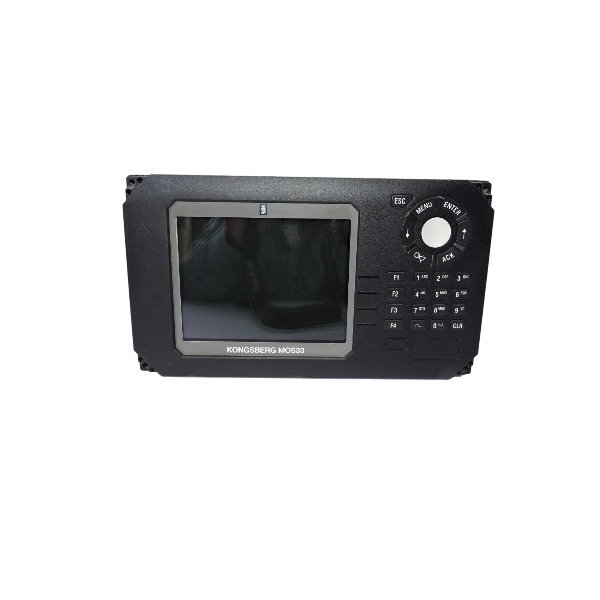







Description
-
BrandKonsberg
-
ModelMOS33-MIDI
-
Product NameMidi Operator Station
-
Place of OriginNorway
-
Customs HS Code8537101190
-
Part number4403239
-
Dimensions250 mm × 140 mm × 70 mm
-
Weight1.54 kg
-
Operating Temperature-15 ℃ ~ +70 ℃
-
Storage Temperature‑25 ℃ ~ +75 ℃
-
Warranty12 month
-
Product Statusnew and original
MOS33-MIDI (Part No.4403239, Kongsberg) Fault Diagnosis Procedure
1. Pre-Diagnosis Preparation
Document full fault conditions including LED indicators, alarm texts, fault pattern (permanent, intermittent, load-triggered), time stamp and associated system events.
Retrieve and save relevant system logs from Kongsberg operational software for subsequent analysis.
Apply ESD protective measures prior to removing terminal covers. Confirm rated supply voltage range before taking any electrical measurements.
Validate part number MOS33-MIDI, 4403239, and record hardware revision as well as installed firmware version.
2. Visual Inspection and Power Supply Check
Carry out visual inspection for burn traces, corrosion, moisture contamination, loose terminals and bent or damaged connector pins.
Measure input supply voltage at the module power terminals using a multimeter to ensure values fall within published operating specifications.
Examine power cables for physical damage, verify proper terminal torque, and rule out loose connections, short-circuits or open-circuits.
Evaluate status LEDs for power, communication and channel conditions:
Power LED off: loss of input power, blown internal fuse or hardware failure inside module.
Solid power LED with no blinking communication LED: module boots successfully, yet communication link is broken.
Irregular LED flashing: internal self-test abort or firmware anomaly.
Execute power-cycle test: keep power disconnected for 3-5 minutes, restore power and observe whether the fault clears temporarily.
3. Communication Interface Troubleshooting
Inspect MIDI/serial wiring for cable damage, shielding earthing status and correct pin-to-pin assignment.
Confirm matching configuration between MOS33-MIDI and host system regarding baud rate, data bits, stop bits, parity and communication protocol.
Check connectors for bent pins, oxidation and poor contact; reseat all detachable connectors.
Capture transmit-receive data stream with serial monitoring utilities:
Zero data traffic points to faulty wiring, incorrect parameters or defective onboard transceiver circuitry.
Corrupted data output indicates mismatched serial settings, ground-loop disturbance or poor-quality cabling.
Disconnect external field equipment and execute port loop-back test to differentiate between internal module defects and external field-side faults.
4. On-Board Self-Test and Firmware Validation
Enter the module diagnostic menu through Kongsberg configuration software and trigger built-in self-test functions. Archive self-test results and error messages.
Review current firmware revision. Perform official firmware upgrade per Kongsberg guidelines if running known problematic older firmware releases.
Warning: Power interruption during firmware download will lead to irreversible module damage.
Hardware error codes returned by self-test suggest defective internal electronic components.
5. Typical Fault Scenarios and Remedial Actions
Symptom 1: Module fails to power up, power LED stays dark
Possible causes: missing or out-of-range supply voltage, blown internal fuse, hardware circuit breakdown.
Actions: Measure input voltage; inspect power wiring. Replace module and arrange factory repair if supply condition is normal yet unit remains non-functional.
Symptom 2: Power supply normal, no data interchange with host system
Possible causes: misconfigured communication parameters, defective cables or connectors, ground interference, faulty transceiver hardware.
Actions: Re-verify communication parameters; substitute with spare cable; implement single-end shield grounding; complete loop-back test.
Symptom 3: Sporadic communication dropout and random garbled characters
Possible causes: loose screw terminals, ground-loop noise, unterminated long-distance cables, excessive power-supply ripple.
Actions: Retighten terminal screws; fit appropriate termination resistor; enhance power-supply filtering; separate signal cables from high-power wiring routes.
Symptom 4: Self-test failure upon power-on
Possible causes: corrupted firmware image, failure of internal hardware components.
Actions: Re-program official firmware. Replace or return unit to factory for repair if fault persists after re-flashing.
6. Post-Troubleshooting Validation
Reinstate all original system cabling after fault handling.
Run minimum 30-minute continuous operation test, confirm no recurring alarms and stable data transmission.
Clear historical fault logs and continuously monitor newly-generated event records.
7. Critical Precautions
Overvoltage applied to signal pins will permanently damage transceiver circuits.
Opening the module enclosure invalidates the original manufacturer warranty.
If faults cannot be resolved through above-mentioned procedures, contact Kongsberg technical support. Submit part number, serial number, firmware version and complete fault logs for professional evaluation.

MOS33-MIDI (Part No.4403239, Kongsberg) Technical Characteristics
General Description
The MOS33-MIDI is a marine-qualified human-machine interface terminal manufactured by Kongsberg Maritime. It acts as a local operator unit to implement alarm supervision, parameter adjustment and on-site operational tasks, and is extensively applied within ship automation and alarm management systems.
Hardware Features
Display: 5.7-inch color TFT-LCD with 320 × 240 pixel resolution, delivering excellent readability under variable onboard ambient-light conditions.
Built-in Keypad: Consists of dedicated function keys, menu navigation buttons and shortcut keys for alarm confirmation, audible alarm silencing and parameter editing.
Ingress Protection: Front panel achieves IP66 rating for flush panel-mount installation; rear housing meets IP22 standard, providing defence against splashing water, dust and humid marine air.
Mechanical Robustness: Enhanced shock-proof and vibration-resistant design, qualified for installation on ship bridge, engine-room and deck zones.
Mechanical Form: Compact panel-mount structure, perfectly suited for confined mounting space of ship control panels.
Electrical Characteristics
Operating Supply: 18-32 VDC, rated at 24 VDC for standard marine DC power networks.
Typical Power Draw: Approximately 10 W during regular operation.
Communication Port: Galvanically-isolated MIDI/RS-422 serial interface, exclusively used for data exchange with Kongsberg main automation controller.
Serial Configuration: Communication parameters including baud rate, data bits, stop bits and parity are adjustable to match host controller settings.
Functional Capabilities
Real-time alarm presentation: displays alarm message content, time stamps, alarm priority and status indicators.
Alarm management functions: alarm acknowledgement, alarm group filter, historical alarm retrieval and event log review.
Local system configuration: modification of operational parameters, alarm text editing, user-access setup and crew permission allocation.
On-board diagnostic utility: visualise communication health, module self-test results and overall system operational status.
Persistent event log storage supporting post-incident analysis and fault troubleshooting.
Certification & Compatibility
Marine Approval: DNV Class-B certification, conforming to IACS E10 requirements for ship-borne equipment.
System Compatibility: Functions as local operator station integrated with Kongsberg marine alarm and monitoring system.
Firmware maintainability: supports firmware upgrade through serial port for feature improvement and bug rectification.
Typical Application Scenarios
Remote alarm-monitoring terminals deployed in engine-room, deck and auxiliary-equipment compartments.
Local HMI for parameter configuration and field-level diagnostic work.
Compact operator panel for shipboard locations with limited installation footprint.

MRU-E-JB1
DPS-110
382-079671
DPU RAi-16xe
RHUB200-5
RSER200-4
PS-11
MRU-D
RMP201-8 324400
RCU501