





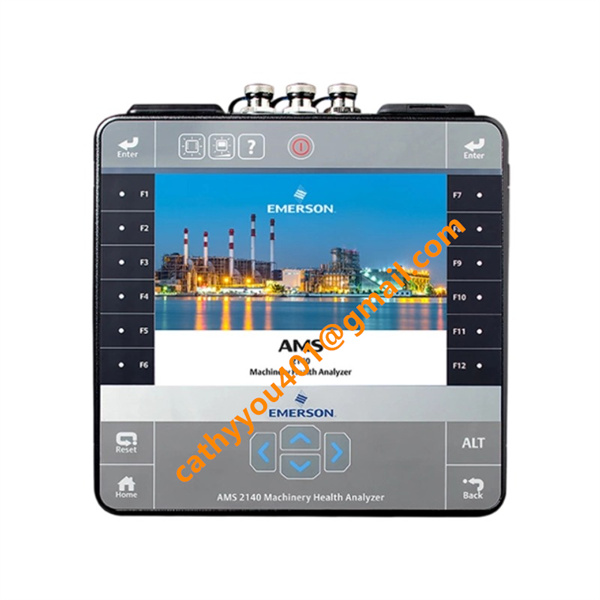








Description
-
BrandEmerson
-
ModelAMS-2140
-
Product NameAMS 2140 Portable Machinery Health Analyzer / Vibration Condition Analyzer
-
Country of OriginUnited States
-
HS Code9027809900
-
Dimensions248 mm×40 mm×226 mm (8.8 in×1.57 in×8.9 in)
-
Weight1.79 kg / 3.95 lbs
-
Operating Temperature-10°C ~ +50°C (14°F ~ 122°F)
-
Storage Temperature-20°C ~ +35°C (-4°F ~ 95°F)
-
Power Supply24VDC
-
Warranty12 month
-
Product StatusNew and original
Emerson AMS-2140 Technical Profile
Electrical Specifications
1. Main Power Supply: Built-in rechargeable lithium-ion battery packNominal Battery Voltage: 14.8 V DC
Continuous Working Current: 350mA ~ 600mA under full-load acquisition
Standby Current: ≤ 80mA
Full-charge endurance: Up to 12 hours of continuous field measurement
2. External Charging Input: 19 V DC / 3.42 A power adapter; supports vehicle-mounted charging and external spare battery charger
3. Signal Input Circuit:4 independent vibration acquisition channels + 1 synchronous phase trigger channel
Input signal type: Industrial accelerometer, speed probe, displacement sensor
Measuring frequency range: DC 10 Hz up to 80 kHz high-frequency vibration signal

AMS-2140 Emerson Wiring & Connection Instructions
1. Vibration Sensor Wiring (Main 4 Acquisition Channels)
Top panel equipped with 4 BNC standard signal ports labeled Channel 1 ~ Channel 4, for connection to industrial IEPE piezoelectric accelerometers.
Wiring sequence: Accelerometer signal cable core wire → BNC center contact; shielding ground wire → BNC outer shell, keep cable shielding grounding well to avoid field electromagnetic noise interference.
Accelerometer installation options: Magnetic base adsorption on equipment housing / bolt fixed mounting for long-term fixed measuring points.
2. Phase Trigger Sensor Wiring
Independent phase input BNC port: Connect tachometer laser speed sensor or eddy current keyphasor probe, used for rotational speed synchronous collection and rotor dynamic balancing phase angle measurement.
3. Power & Communication Wiring
DC charging port: Located on side panel, connect matched 19V DC power adapter for battery charging; car charger cable can be connected for on-road charging.
Wired data communication: Micro USB interface for offline data export, firmware upgrade and wired connection to industrial computers.
Wireless connection: Activate built-in Wi-Fi module, connect with industrial laptop or AMS management platform for wireless data transmission without cable layout.
4. Motor Electrical Diagnostic Wiring
External voltage/current clamp accessories connect via auxiliary input ports to realize motor stator winding fault, rotor bar breakage, power supply harmonic electrical signature analysis.

AMS-2140 Emerson Core Product Advantages
1. Leading PeakVue Plus Patented Technology: Captures high-frequency stress wave impact signals to realize ultra-early detection of bearing fatigue, micro abrasion and gear tooth damage, detecting mechanical faults months earlier than conventional vibration analyzers.
2. 4-Channel Simultaneous Acquisition: Collect multi-point vibration data synchronously to drastically improve field inspection efficiency, applicable for complex multi-support rotating equipment and dual-orbit sleeve bearing analysis.
3. All-in-one Functional Integration: Combines route data collection, advanced spectrum vibration analysis, single/two-plane rotor balancing, motor electrical signature analysis (ESA) and pre-configured intelligent diagnosis expert modes in one handheld unit.
4. Ergonomic Rugged Handheld Design: Supports one-hand long-hour operation, backlit touch LCD screen with automatic ambient light adjustment, dust-proof drop-resistant industrial casing, built-in support stand for field placement.
5. Wireless & Wired Dual Data Transmission: Built-in Wi-Fi hotspot for real-time remote uploading of on-site measured data to Emerson AMS Machinery Health Manager software for centralized asset management, trend analysis and automatic maintenance report generation.
6. Intelligent Guided Measurement: Pre-set machine type parameter templates, step-by-step operation prompts lower technical operation threshold for maintenance staff.